
United States: land of dreams, hopes… and waste!

If Americans are known for their quest for excellence, perhaps they’d rather avoid this trophy because… they are the champions of waste! Indeed, the United States (U.S) discards more food than any other country in the world: nearly 80 million tons every year, 33% of all food in the U.S. The reFED has established that Americans homes are the main wasters with 48% of the food thrown away but consumer-facing businesses follow close with nearly 20% of waste. Groceries represent more than 4M tons.
Let’s say the American Dream has not yet happened regarding food waste!
But when there is a challenge and need to make a difference, here again, the U.S is undoubtedly the best! America is progressively realizing the fight against food waste is a great opportunity, at a national level to offer a better distribution of resources and at a retail level to gain margin points and answer new consumers’ expectations.
As Smartway will be participating in the next edition of the NRF Retail’s Big Show in January, we decided to dig more into the situation regarding food waste across the Atlantic.
A big picture you can discover now.

Strong immigration roots shape the food situation
The genesis of the United States is unique as that country was founded by immigrant settlers in the 16th century. The concept of the “American Dream”, the belief that any person living in the U.S, through hard work, courage and determination, can become prosperous, has quickly emerged and accelerated immigration. This rich patchwork of cultural diversity has profoundly influenced the U.S relationship with food. Immigrants from all over the world have brought their unique culinary traditions and eating habits which have passed through generations. This fusion of cultures has contributed to the way food is valued and consumed in this vast territory.
However, this diversity has increasingly existed alongside significant issues regarding food. Indeed, food insecurity and waste have risen. A 2024 report by the U.S. Department of Agriculture’s Economic Research Service announced that 18 million households were food insecure in 2023. 13.5% struggled with food insecurity at least some time during the year in 2023. And regarding waste, it is nearly 80 million tons every year.
While some communities have the privilege of abundant food choices, ending by wasting, others, mainly minorities, face barriers in accessing nutritious meals. The paradox of food abundance coexisting with food waste and food inequality reflects the complex dynamics of the nation’s food system.
A vast country, blessed land for agriculture…
The United States is a vast country, where its inhabitants managed to enhance their natural resources to have access to food. This notion of production is like nowhere else. If Europe initiated industries, the U.S. learned faster and harder in ways that Europe simply couldn’t offer. The American method of production is incredibly efficient, and agriculture is a flagship of the American economy. Almost 40% of American land is devoted to agriculture (pastures and crops). Agriculture, food and related industries contributed 5.6 % to U.S. gross domestic product (GDP).
Have you heard about the Midwest known as “America’s breadbasket”?
Much of the nation’s crops are produced there, with over 127 million acres of farmland across the region of which 75% of corn and soybeans. But where there’s production, there’s also waste… In Illinois, every year, 19 million tons of waste is landfilled of which 20% of food, which is more than any other waste stream found in landfills. And let’s remember that when food waste decomposes, it produces methane – a greenhouse gas that is 25 times more harmful than carbon dioxide – and traps radiation in the Earth’s atmosphere.
And indeed, the U.S has natural resources to make farmers dream! It benefits from vast areas of fertile land and diverse climates which can support a variety of different crops. Innovation never stops: there is historically strong governmental support and investments in agricultural research through the U.S Department of Agriculture – USDA – and land-grant universities.
This federal powerhouse of agriculture and innovation offers one of the most diverse and abundant food supplies globally.
… But still not offering an equal access to food
Yet, this wealth is unevenly distributed and a lot wasted, reflecting the complexities of a federal system where states manage their own policies and resources. While urban centers and affluent communities enjoy easy access to nutritious food, rural and low-income areas often face “food deserts”, some regions with limited access to affordable and healthy options. The access to fresh fruits and vegetables is particularly concerning. According to the USDA, over 18 million people lived in food deserts in 2019. Areas where there’s a prevalence of convenience stores and fast-food restaurants harmful to health, high in fats, salt and sugar but also… areas of waste, with less concern and education about food waste.
An economy boosted by its own domestic market and what it means regarding food
A very important marker of the American economy is that the vast majority of American production is absorbed by the domestic market, of huge physical size and purchasing power. Today, the U.S alone accounts for around a quarter of global consumption. To say that the domestic market is the engine of economic growth in the U.S would be an understatement. This robust domestic dynamic has the ambition to ensure access to food for the vast majority of Americans. The 50 states across this vast country and the American enrichment – 20% of households earn more than $100,000 and 2% more than $400,000 – mean that food production is tailored to meet high demand, with supermarkets and restaurants used to stock… to excess. A conjoint study by Smartway and Opinion Way about the food waste in France and worldwide shows that 51% of Americans prefer stores whose shelves are always well filled-in, a major criteria taken into account by stores. Certain categories of consumers are therefore used to have access to a wide variety of foods and end up wasting them. 45% of Americans declare paying attention to food waste – to compare, it’s 59% in France. So, this culture of abundance also has its downsides.
A particular culture of food consumption, accelerator of waste
This abundance contributes significantly to food waste. With food seen as plentiful and relatively inexpensive, many Americans undervalue it, leading to over-purchasing, poor planning, and wasteful behaviors. Our study with Opinion Way shows that the subject is not yet tackled by households, as 44% declare they throw away at least 5 types of products every month. Americans are often impulsive in their food purchases, unrealistically assessing how much food is required, and as a result buying more food than they need or buying food they won’t actually eat. The result is staggering: 33% of all food in the U.S. goes uneaten, representing a loss not only in economic terms but also in resources like water, energy, and labor used to produce the food. That’s almost 149 billion meals’ worth of food that goes unsold or uneaten each year, roughly 1.8% of U.S GDP. Retailers and food producers also play a role, discarding perfectly edible items that don’t meet aesthetic standards or overestimating supply needs. U.S is at a crossroads and needs a cultural shift to better appreciate the food value and reduce waste while maintaining the accessibility that defines the American food landscape.
How does food spending account for American households?
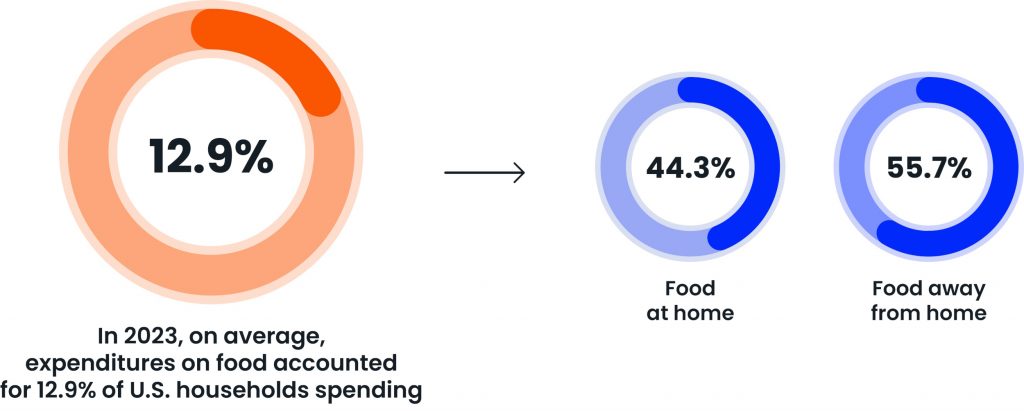
In 2023, on average, expenditures on food accounted for 12.9% of U.S. households spending, an increase from 12.8% in 2022. It ranked third behind housing (32.9%) and transportation (17.0%). Based on a review of USDA, in 2023 Americans spent 44.3% of their food budget on food at home – an all-time low – while their spending on food away from home reached 55.7% – an all-time high.
Food is a very important part of America’s culture. It is a strong symbol of representation: from the success of a family to the values people want to uphold in their daily lives. There’s also a tradition of celebration around meals and food in abundance: for example the Thanksgiving turkey is a must-have to share with families and friends. 14 billion of $ are spent each year for food by consumers. The U.S is finally notorious for having larger portion sizes than other nations, with foods and drinks available in super-size proportions. An accelerator of waste as quantities are overestimated!
The rising waste at all levels of the American society
Nearly 60 million tons are wasted every year in the U.S.
The following number is not less scary: this is the equivalent to almost 40% of the entire U.S food supply that is thrown away. To illustrate? That’s like every person in the U.S throwing 975 average sized apples right into landfills. Indeed, with 22%, food is the single largest component taking up space inside U.S landfills. Composting is not yet an important part of North-American culture. The amount of food wasted in America has an approximate value of nearly $218 billion, with 149 billion meals’ worth of food that goes unsold or uneaten each year.
We saw many reasons for accelerating waste in the U.S society in this article, from complex landscapes of socioeconomic disparities, ingrained beliefs, human behaviors and habits.
There’s also a major misunderstanding of labels by American households. Food spoilage, whether real or perceived, is one of the biggest reasons people throw out food. 58% of American households declare the expiration date is their principal argument to throw away food. And an interesting number is also that 64% discard food because of the products appearance only. Perfectly good and consumable food is too quickly sacrificed. Labels like “sell by”, “use by”, “expires on”, “best before” or “best by” are confusing to people. They’ll prefer to throw it than potentially be ill.
What we saw at Smartway is that the American retail industry, a major player of the ecosystem with some huge worldwide actors, has a food waste issue. Indeed, if waste is coming first from America’s homes – 48% -, consumer-facing businesses follow close with nearly 20% of waste. Groceries represent more than 4M tons. Retail stores generate about 16 billion pounds of food waste every year.
They face a number of unique challenges. We saw that customers generally demand that a variety and quality of food be readily available, adding strain to inventory management.
Changing storage practices and order habits is not an easy move in a vast country with strong traditions and some practices intricately tied to their brand identities. In a competitive market, high customer standards for freshness finally lead stores to throw away edible food.
Wasted food from the retail sector is valued at about twice the amount of profit from food sales. What a loss!
A horizon of improvement to fight food waste in the U.S
But the US is a famous land of hopes. And the fight against food waste is a national issue which can and will be improved for sure!
Governmental efforts are on the move. On a national level, the USDA and the U.S Environmental Protection Agency (EPA) set a goal in 2015 to reduce food waste by half by 2030. In June 2024, the White House announced the National Strategy for Reducing Food Loss and Waste and Recycling Organics. Several states across the country are also taking action to curb food waste and gain food recovery.
The main retail players of the U.S have also measured the impact of waste for the environment and their profits and are implementing specific strategies to reduce their waste. They also work together: “Champions 12.3” is a coalition of executives from governments, businesses and international organizations dedicated to inspiring ambition, mobilizing action, and accelerating progress to achieve the Sustainable Development Goal Target 12.3 by 2030. In this program, the “10x20x30 initiative” brings together 10 of the world’s largest food retailers and providers, each engaging at least 20 suppliers to halve food loss and waste by 2030. Walmart and Tesco are actively involved in this initiative.
A new study from the Pacific Coast Food Waste Commitment shows that grocery retailers made the most significant progress ever reported in the U.S. on reducing food waste in the sector. From 2019 to 2022, retailers decreased by 25% the number of tons of unsold food in their regional operations – nearly 190,000 tons of food valued at $311 million. Significantly, it is an estimated 30% decrease in the total carbon footprint also.
Recent polling confirms that the majority of Americans believe food waste is a critical issue, which over 80% of respondents said they are taking steps to address at home. Consumers, by being more aware of their planet’s future and the preservation of resources, can put pressure on retailers to change their model. In the study “Food waste in France and worldwide” by Smartway and Opinion Way, we discovered that:
- 73% of Americans feel that food retailers are not doing enough to reduce food waste
- 58% of American households declare stores near their homes don’t offer any discount
- 87% of Americans want food retailers to offer more discounts on products that are close to their sell-by date.
Moreover, there’s a critical public health issue around food and the obesity phenomenon and the need to recycle products which would usually go in the bin in stores to offer low-income consumers better and affordable goods.
Now more than ever, all players in the food system, including government agencies, food retailers and consumers must take significant steps to rethink the way Americans eat.
Americans use to say about their country “if there’s one place where you can succeed, it’s here!” So, at Smartway, we are convinced we can efficiently change habits regarding waste in the American retail industry! Let’s build a zero waste future together!