
Making the best out of food waste

Many options are available to retailers that want to dispose of their almost expired food items. They can discount them, donate them to charities, group them into baskets, give them away to animal food product industries… All these solutions are efficient if you want to avoid throwing anything away, but they are very different if we look at them from a financial perspective. Two methods are worth considering to make the best decision: value, and volume.
The value approach
This method focuses on the amount of money each choice will save, including taxes.
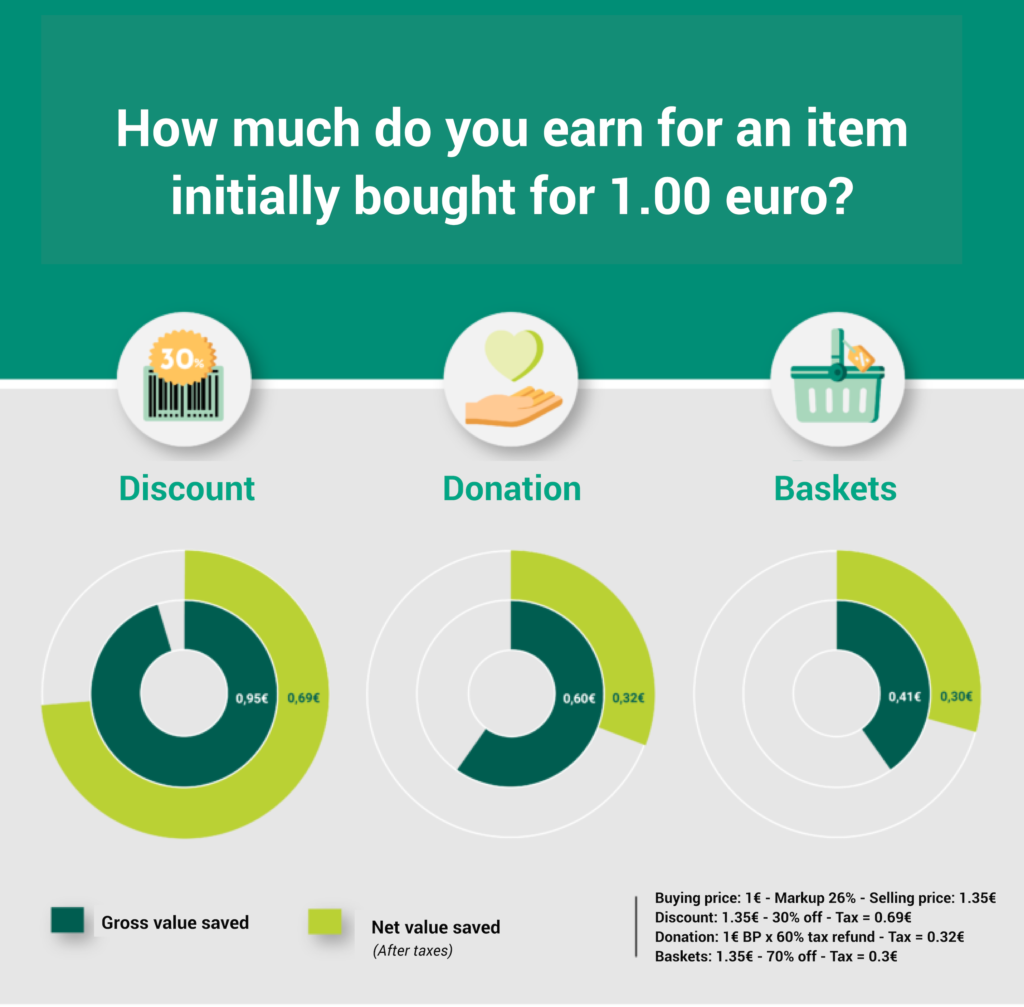
For an item bought 1€ (please note that these are French rates, but the same proportions are approximately correct around the world):
- Discounting: -30% off the selling price means a gain of 0.95€ before taxes, then 0.68€ after.
- Donation, in France and for stores with profits: 0.60€ before taxes, 0.32€ after fiscal refund. The refund will be null if the store isn’t profitable during the current year, but it will be applicable during the next five fiscal years.
- Baskets with a -70% discount: 0.41€ before taxes, 0,29€ after.
- Animal food products: 0€
For example, with 100.000€ gross waste: each path will equally reduce trash fees, but some of them will allow the store to get more money. Discounts will save 68k€ after corporate taxes, donations 32k€ after tax refund, baskets 29k€, and animal food products 0€.
Thinking with value only, discounting the food items seems like a no-brainer. Yet, volume matters, and other indicators have to be considered.
The volume approach
Focusing on volume means thinking about the number of items saved. It is complementary to the value method, and wouldn’t be an appropriate tool without it. A high volume in this situation is only a good sign if the value is the best as well.
- Discounting products allows for a resale rate of about 80%. This is high, but not enough to reach 100%.
- Donations usually complete it. However, some products cannot be donated, and the tax refund is capped at 0.5% of a store turnover. This is also time-consuming and depends on charities’ efficiency.
- Baskets have a lot of success: they are cheap and full of surprises for customers. But they also demand time to be prepared, good homogeneity, and a high selling value to begin with (between 15 and 20€).
- Animal food products are the easiest way to save time and deal with most of the food waste. But is not saving value. It’s mostly advised for products nothing else could save.
Combining value and volume to reach zero food waste
The obvious goal is to save every product AND a maximum amount of money. Doing that requires both methods.
Doing one without considering the other would throw the food waste management system off balance, and would complicate the readings for the main metrics.
In order to help with the improvement of this process, we developed tools and a simulator to check the best market approach it provides.
This simulation is validated by finance experts. Every store can project its results, for free. Thanks to this tool, they will be able to start the food waste management process or optimize what they already have.